

1835
Nearly all Wisconsin Land had been ceded to the U.S. We see the first recorded migration of Irish settlers. Patrick Murray, William and Robert Shields, George Furlong, David Curtin, and Martin Delaney arrive in 1835. Among the Irish, German and French homesteaders begin to build Milwaukee into the city we have today.
1843
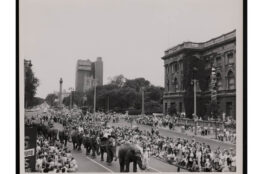
The first St. Patrick’s Day parade in Milwaukee is sponsored by the Wisconsin Total Abstinence Society and draws about 3,000 marchers from all over southeastern Wisconsin.
1845
The year of the Potato Famine. An influx of Irish immigrants begin to flood the U.S. Some ventured West, because land was cheaper, and they would have more religious freedom than on the East coast.

Experience an unforgettable evening celebrating great design!
1848
Milwaukee’s Irish population grew to 15% of the inhabitants.
1850s
The Third Ward, which was regarded as an Irish ghetto, was nicknamed the Bloody Third Ward because drunken violence frequented the outer edges.
1852
The Irish caucus passes a motion to condemn Britain for the imprisonment of Thomas Francis Meagher and his associates following the Young Irelander Rebellion, showing international support and ethnic ties to Ireland.
1860
The Irish population in Milwaukee peaks in the 19th century at 49,961.
1880
The Irish population declines to 41,907. Since 1860, more German immigrants moved to Milwaukee and the Irish began to leave. Germans would discriminate against the Irish and German predecessors held public office favoring their heritage.
1992
There was a Great Fire in the Third Ward, and many moved away from the city center. It destroyed 440 buildings and left about 2,500 people homeless, most of whom were Irish. Most did not return and moved across the river to an Irish community at Merrill Park on the city’s West side and to the Holy Rosary congregation on Oakland Avenue. Some left Milwaukee entirely. Mostly Italians occupied the area, and it became an Italian neighborhood. Cornelius Corcoran, an Irishman, was elected as alderman for the Third Ward in the same year.
1900
The population almost halves since 1880 to 23,544 Irish in the city. Immigrants such as Italians, Greek, Slovak, Serbian, Croatian and Slovenian begin to take the pressure off the Irish as minority figures.
1916
While almost all political seats were held by Germans, Daniel Hoan, an Irishman, was elected and became the longest serving Mayor of Milwaukee with 24 years of service. He was a socialist and launched a public bussing system.
1930s
The Irish immigration wave drastically slows and only 1.4% of Milwaukee population report an immediate family member born in Ireland.
1946
Milwaukee elects Joseph McCarthy, a staunch Republican and anti-communist. He would live in infamy for what is now known as McCarthyism.
1970
The Hoan Bridge is constructed and named in honor of Mayor Daniel Hoan.
1981
Milwaukee’s first Irish Fest!
2004
Mayor Tom Barrett is elected. Coming from both Germanic and Irish ancestry, he represents two ethnicities from Milwaukee’s heritage.