

With Slumdog Millionaire, Danny Boyle has exuberantly blended the perfect combination of John Steinbeck and Walt Disney. Like the classic Bollywood movies that make India’s film industry the largest in the world, it’s a fairy tale set against the chaos and squalor that is India, only this time, the squalor isn’t just subtext.
Boyle and his screenwriter, Simon Beaufoy, announce it from the film’s first set piece. Locked in a latrine by an impish friend, a street kid jumps through the hole into the muck so he can escape in time to nab an autograph from a passing Bollywood star, “the most famous man in India.” The rest of the story is just that—a journey from offal to opulence.
Boyle both wallows in and soars over India’s turbulent landscape. On the ground, he relishes Dickensian detail, creating a world of savvy street urchins to rival Oliver Twist and his gang. But in the dazzling opening chase through the Mumbai slums, he jumps between jerky alley-level chases and soaring overhead patchworks of corrugated metal roofs. And every cut capture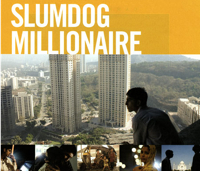 s something about postmodern India’s clash of wealth and poverty.
The story, loosely based Vikas Swarup’s novel, Q & A, puts us right in the midst of that culture clash during India’s last two turbulent decades. Jamal is a tea boy at a Mumbai call center who becomes an unlikely contestant on India’s version of “Who Wants to Be A Millionaire” (the show is franchised in dozens of countries worldwide). For much of the caste-conscious Indian audience, he’s a joke, and the oily host (Anil Kapoor) walks a fine line between condescension and mockery. But as Jamal moves further toward the final question, he becomes a national folk hero—crowds cluster around TVs scattered through the slums to cheer him on.
But when we first meet Jamal, he’s under arrest, accused of cheating of the show, and his life story spins out as he tells a detective how he knew all the answers—each one corresponds to a vignette from his harrowing young life.
Slumdog works so well because it appeals to Boyle’s cinematic assets—post-punk grittiness and “when-you-with-upon-a-star” fantasy. Like his breakthrough film, Trainspotting, Slumdog revels in the Mumbai’s babel and buzzes with its frenetic rhythms (he’s helped by A.R. Rahman’s pulsing worldbeat score). But his hyperactive verite style doesn’t make us want to change the world; it drives us headlong into Jamal’s fantasy. Even as anti-Muslim thugs are literally setting fire to people in the streets, Boyle keeps our eyes on the prize—will Jamal save the day, get the girl, win the 20 million rupees and live happily ever.
You don’t have to be an expert in Bollywood cinema to predict how it all turns out.
Slumdog Millionaire-
With Slumdog Millionaire, Danny Boyle has exuberantly blended the perfect combination of John Steinbeck and Walt Disney. Like the classic Bollywood movies that make India’s film industry the largest in the world, it’s a fairy tale set against the chaos and squalor that is India, only this time, the squalor isn’t just subtext. Boyle and his screenwriter, Simon Beaufoy, announce it from the film’s first set piece. Locked in a latrine by an impish friend, a street kid jumps through the hole into the muck so he can escape in time to nab an autograph from a passing Bollywood…