
Charles McNeer was viewed as one of the town’s top business and civic leaders. The Wisconsin Energy Corporation executive eschewed the low-rent suburbs and kept his headquarters and 2,000 jobs Downtown – yet kept electric rates low and profits high.
But nobody had ever seen McNeer’s personal side. He broke down crying in an interview for a November 1987 story by Mary Van de Kamp Nohl. Recalling the suicide of his 24-year-old daughter Suzanne, McNeer said, “you expect your parents to die; you might even expect your spouse to die, but you never expect your child to die and certainly not take her own life.”
Not everyone we interviewed was so shockingly candid, but the humanity, successes and mistakes of many business leaders were frankly documented in these pages over the years.
Winners and Losers: In “Revenge of the Nerd” (April 1989), Nohl chronicled the upset victory of Manpower CEO Mitch Fromstein, who battled the odds – and an unfriendly British takeover – to take back his company. Manpower, as a result, is still a leading company, and it recently moved from Glendale to a Downtown location.
Other winners included Roy Reiman, who became one of the country’s most successful publishers – with 13 million subscribers to magazines such as Birds & Blooms and Taste of Home– before selling out to Reader’s Digest in 2002 for $760 million. Our May 1998 story described how Reiman was reinventing Greendale’s dying downtown with quaint shops and a corporate visitor’s center. You can call it Pollyanna, Reiman said to writer Elfrieda Abbe, but “we’re trying to recreate the small-town atmosphere I grew up in.”
Then there’s developer Gary Grunau, who became one of the city’s most powerful men by sticking his neck out (August 2006). “You can divide the world into doers and whiners and Gary Grunau’s a doer,” wrote Nohl, documenting the residential rebirth north of Downtown after he bought and developed the dormant 40-acre property once owned by the Schlitz Brewery.
In contrast to McNeer and Wisconsin Energy was the tragic tale (January 2001) of successors Richard Abdoo and the renamed WE Energies. The company, Nohl wrote, was slapped with the largest environmental damage judgement in state history, $104.5 million, for shirking responsibility for millions of tons of cyanide-laced wood chips dumped onto private property. Abdoo also provoked a shareholder rebellion by presiding over a 30 percent decline in the company’s stock and dividends.
Another company with environmental problems was Menards, which had a long list of violations cited by the state’s Department of Natural Resources. Nohl’s May 2007 article described how farm boy John Menard became the state’s richest man (worth $5 billion), building his Menards chain on ingenuity, distrust and lots of penny-pinching.
The Smoke-filled Room: The Greater Milwaukee Committee, a business leadership group, was sometimes spanked for driving the community’s agenda “with as many private meetings and as little public discussion as possible,” as writer Bruce Murphy put it (September 1988). But Murphy noted that the first GMC members helped jump-start civic projects in the late 1940s, a time when the city was horribly in need of modernization.
For 17 years, beginning in the mid-1980s, the GMC was led by Bob Milbourne, a former policy wonk for Gov. Patrick Lucey and a rare Democrat in a room filled with Republican business leaders. It was McNeer who had recruited Milbourne, Nohl wrote, because he “wasn’t afraid to ask the hard questions.” The two men helped the group move from the old style of championing building projects like freeways and the zoo to taking on social issues like teen pregnancy and high school dropouts. The results were mixed at best: the creation of the Greater Milwaukee Education Trust, as a November 1994 story documented, was a bust.
The decline in the number of corporate home offices and the intractability of the city’s social issues contributed to a decline in the GMC’s influence. Milbourne moved to Columbus, Ohio, in 2002, and was succeeded by Julia Taylor. In a symbolic move, she relocated the GMC headquarters from an exclusive high-rise to the modest, more accessible confines of the old Grand Avenue Woolworth’s. But it remains to be seen if Taylor can accomplish more than symbolism for a group that “seemed to lose its way,” as writer Barbara Miner noted in a February 2004 story on Taylor.
The John and Tim Show: The town’s other major business group, the Metropolitan Milwaukee Association of Commerce, was run for 21 years by John Duncan, a “mystery” figure and a “behind-the-scenes kingmaker,” as Nohl wrote in September 1988. Said a former employee, “He knows where the bodies lie … he makes a damn good friend and a damn good enemy.”
Under Duncan, the MMAC became the first U.S. chamber to form a political action committee to support political candidates. But he had no interest in task forces or social problems. (Duncan died in 2003.)
While the stealthy Duncan avoided the press, his successor didn’t. Tim Sheehy, who took over as MMAC president in 1992, openly courted the media, writer Kurt Chandler noted in January 2006’s “Hot Shot.” Under Sheehy, the group loaned millions to the Milwaukee Brewers to keep the team going and helped hammer out a deal to fund a new baseball stadium. It also led a campaign supporting school choice. Yet even though the group is now more high-profile and wide-ranging in its interests, membership has declined 22 percent, and the Madison-based Wisconsin Manufacturers & Commerce has replaced it as the state’s top business lobby.
This Bud’s For You?: No private company was covered more heavily in these pages than the Milwaukee Brewers. In a series of stories, Murphy revealed the company’s complex structure (April 1994) and told how Bud Selig parlayed an initial investment of about $100,000 into the biggest ownership share. Murphy’s April 1996 cover story documented how taxpayers were investing far more in the team than its owners ever had, and it argued the stadium should be built Downtown. (Alas, it was not.) His April 2001 feature documented the total costs to taxpayers of $1.1 billion – and that’s likely to rise, given recently announced plans to upgrade the sound system and scoreboard.
Labor vs. Business: As manufacturing companies began exporting jobs overseas to low-wage countries, labor-management tension increased. “Could Fred Be Right?” asked our October 1994 cover. Briggs and Stratton CEO Fred Stratton was considered “a public enemy, a greedy exporter of jobs,” writer Steve Filmanowicz noted, but the union was part of the problem. As one Briggs vice president described the union contract and rules, “I’ve seen Bibles that are more condensed.”
The steps taken by Briggs kept the company here, though with less workers. Twenty years later, the story of Master Lock (November 2004) was even more sobering, as the company dropped from 1,300 workers to 300, with many jobs exported to Mexico. “Can you maintain a high standard of living in a nation where you don’t produce anything?” asked one labor leader, a question that still haunts this community.
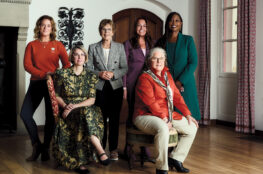
Women and Power: A groundbreaking feature (April 2002) told how Milwaukee’s largest publicly traded companies badly lagged the nation in female officers and board members. The story inspired the creation of an organization of professional women, Milwaukee Women Inc., to underwrite continuing research on the topic.
“Women are not, even now, full and equal partners in the leadership of Milwaukee or Wisconsin. This is three decades after substantial numbers of women graduated with the proper academic credentials,” Nohl wrote.
In March 2006, Nohl revisited the topic, reporting dramatic improvements at four of the five companies labeled the worst workplaces for women in 2002. Under CEO Dennis Kuester, M&I Bank had increased the number of female senior managers by a remarkable 88 percent.
But alas, the overall pace of change has been slow, as an updated report by Milwaukee Women Inc. reported in fall of 2007. “At the current rate (of progress),” the report concluded, “it will take upwards of 60 years for (Wisconsin) women to reach parity with men.”