Milwaukee has a well-deserved reputation as a town that likes to drink. Whether it’s our fondness for brandy or our reluctance to stop at two beers, we generally land at or near the top of the national rankings in all things alcoholic.
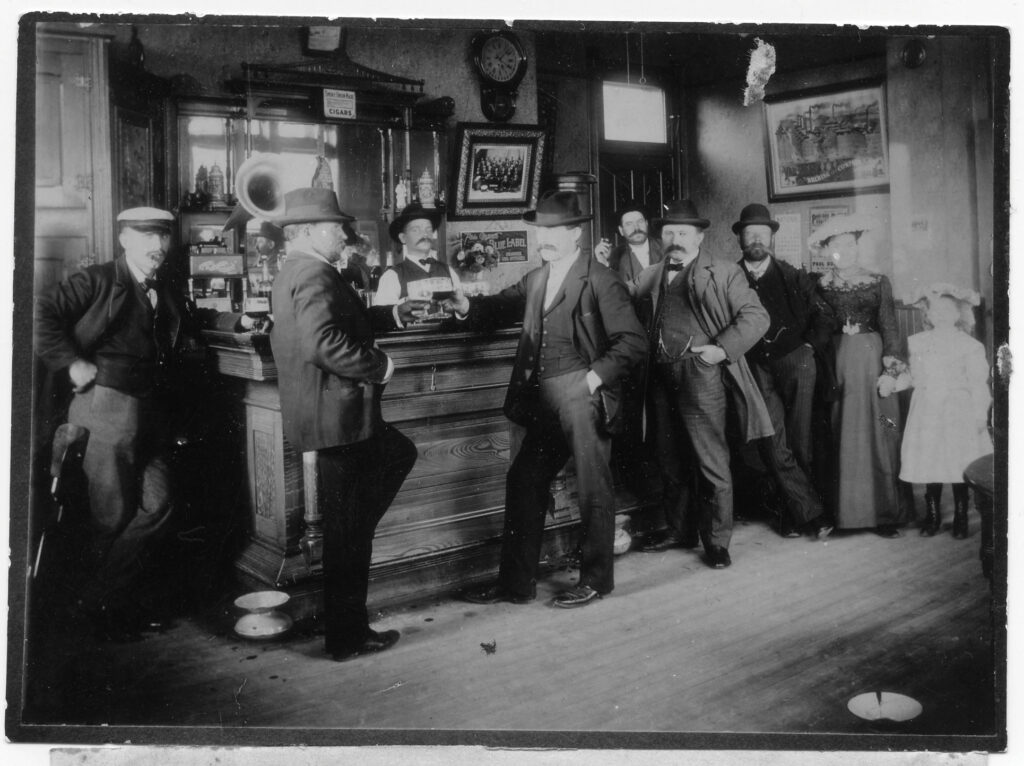
Our status as a capital of tavern culture began early. Milwaukee, in fact, had corner bars almost as soon as it had corners. Schauss’s saloon, pictured here in 1895, was typical. Dominating the corner of Eighth and Burleigh, it was owned by a German family and attracted working-class Germans from the immediate neighborhood.

Know somebody making an impact in Milwaukee?
Although Germans didn’t invent drinking in Milwaukee, they were major influencers. During the frontier period, most local saloons were “rum holes” that served liquor as rough as their clienteles. Beginning in the 1840s, beer-loving Germans shifted the community’s tastes toward their national beverage. Nearly two dozen breweries were in business by 1860. All were micros by modern standards, but their owners had names like Best (the future Pabst), Schlitz, Miller and Blatz.
Industrial expansion swelled the fortunes of those beer barons. Thousands of European immigrants, many from Poland, came to Milwaukee in search of jobs, and long days in hot factories created prodigious thirsts. By 1895 the city directory contained listings for nearly 1,700 saloons – one for every 140 men, women and children. Most were “tied houses,” serving the products of a single brewer exclusively. German names predominated, from Ahlhauser to Weifenbach, but there was a liberal admixture of Andrzejewskis, Wojciechowskis, and other Polish saloonkeepers.
More than 130 years later, those are all gone, including Schauss’s. Deindustrialization, the demands of running a saloon and shifting attitudes toward alcohol have whittled the city’s census of traditional bars to roughly 300, less than a fifth of their former numbers. The day of corner taverns as “workingman’s clubs” isn’t entirely gone, but it’s fading steadily into the sunset.
TAKE A CLOSER LOOK:

- This Edison phonograph was an early equivalent of today’s jukebox.
- Dark beer, perhaps bock, was on tap when the photographer visited.
- Spittoons were standard décor in 1895. Not everyone’s aim was true.
- This lithograph of the Blatz brewery marks the saloon as a tied house serving only Blatz products.
- Schauss’s was a family establishment where a mother and daughter could visit without trepidation.
IN COLLABORATION WITH THE MILWAUKEE COUNTY HISTORICAL SOCIETY