
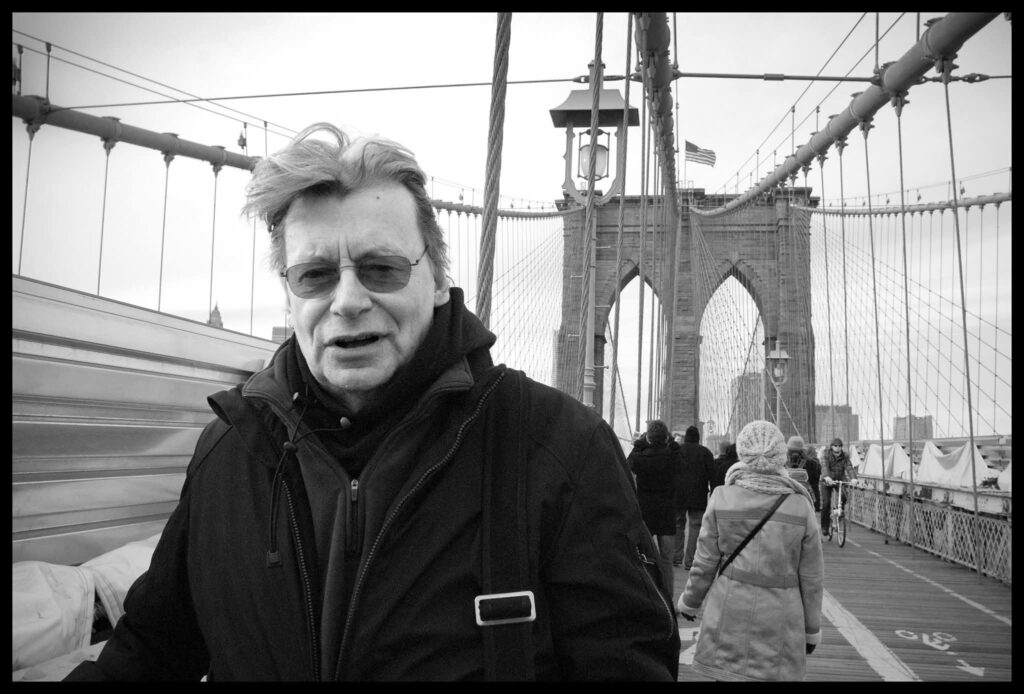
Revered Milwaukee portrait photographer Francis “Frank” Ford gained fame for photographing the famous and not-so-famous in a career that spanned more than 50 years.
His work was featured in publications from Rolling Stone to Newsweek to Creem to Milwaukee Magazine, with a diversity in subjects to match: filmmaker John Waters, longtime Milwaukee Mayor Frank Zeidler, writer Hunter S. Thompson, decades of drag queens, the BoDeans.
Ford died on Sunday at the age of 80.
Born in Milwaukee and raised in Whitefish Bay, Ford got his start as a photojournalist for national news wire services, which included photographing the Democratic National Convention in Chicago in 1968 before he zeroed in on portraiture and teaching photography at the Milwaukee Institute of Art and Design, which he did for more than 25 years.

Check It Out!
Ford continued his photography work until about five years ago, when he retired due to health issues.
While he had an international profile for his work with celebrities, he worked extensively locally, too. As a regular contributor to Milwaukee Magazine, his photographs appear on several of our covers. He was also photo editor of Milwaukee-based Art Muscle Magazine for more than a decade.
“He had a very unique perspective. Really arty and pure, not commercial,” says Sharon Nelson, who worked with Ford for several years as Milwaukee Magazine’s art director from 1979 to 2005, “He didn’t put on any stylizations to make his photos more commercially successful. He was just a really good artist.”

Nelson recalled assigning Ford to shoot photos of local professional wrestling events.
“We did this feature about real dramatic wrestling in Milwaukee,” she said. “There were some really gross pictures of guys all bloodied up. Frank brought the photos in and I thought they were amazing. He said afterward, ‘I can’t believe you ran the photos that I shot,’ but they were great.”
Nelson described Ford as a “real free-spirited kind of guy.”
“He was a very nice person to work with – sensitive and funny. Just a great guy,” she said. “He didn’t dress the part or put on airs at all.”
A ‘Fantastic Take on Everything’
Ford lived in Shorewood with his partner, Julie Duchaine. The couple first met at a charity fundraiser.
“We conversed and we exchanged cards and he suggested that maybe we meet for a cup of coffee. Then we started having coffee dates and that evolved into a relationship,” Duchaine says this week. “I had known of his work before. He was an amazing photographer and I really enjoyed his work. I went to a couple of his shows in the ’80s and ’90s around town, but I really didn’t know much about him as a person. I just knew he was legendary and had a remarkable history.”
Beginning in 2000, Ford embarked on a series of collaborations with Milwaukeean Jack Eigel that included the acclaimed Men of Leisure, a project that addressed the near-death experiences and subsequent life changes that both experienced – but in a playful, whimsical tone.

Ford experienced a bleeding aorta in January 2010, and although he wasn’t expected to survive emergency surgery, he went on to make a full recovery. Eigel experienced cardiac arrest in 2007 and his heart deteriorated in the subsequent years to the point that he needed a full transplant.
“I went from collaborating with him to providing rides to medical appointments,” he said.
Duchaine said Ford had a second aortic aneurism recently that led to his death. He also had also been placed into memory care. “He had one before that was repaired and got some miracle years out of that, but this one was inoperable,” she said. She and Eigel were together by Ford’s side when he passed.
This week, at his Wauwatosa home, Eigel reflected on Ford’s life while sharing his friend’s photos. “He had a really fantastic take on everything,” he said. “He was kind, but he was a little tongue-in-cheek about things.”
Eigel said the five shows he collaborated on with Ford were “fantastic and frustrating at the same time.” “He was a temperamental artist,” Eigel said. “We wound up over the course of years doing 110 photos. For each photo we scheduled, I probably had to reschedule it two to three times before it actually occurred. It was a bit of a labor of love with Francis, always.”
As Eigel searched through Ford’s photos, several stood out to him. “The photo he took of [fashion and portrait photographer] Richard Avedon is of course iconic,” he said. “There’s a photo he did of two of the Munchkins as adults that’s a pretty standout photograph. I also love his picture of the conductor Kenneth Shermerhorn [music director and conductor of the Milwaukee Symphony Orchestra]. It was a really great picture that takes you back to that era in Milwaukee. He photographed people from all walks of life.”

An Outpouring of Tributes
Many members of Milwaukee’s creative community have posted social media tributes to Ford this week following word of his death.
“The world has lost a truly treasured, incredibly talented man. I am honored to be part of his lifeboat,” artist and close friend Carri Skoczek said in a Facebook post.
Jeff and Dana Redmond, operators of Scout Gallery in Bay View, worked closely with Ford in 2018 on his WMSE calendar show at RedLine Milwaukee. “Scout Gallery is devastated to hear of the recent passing of Francis Ford, an incredibly kind soul, endlessly fascinating character and one of Milwaukee’s most talented photographers/artists,” the Redmonds posted on Instagram.
Mikhail Takach, curator of the Wisconsin LGBTQ History Project in Milwaukee, wrote a blog post lauding Ford as a chronicler of Milwaukee and its people working-class neighborhoods, counterculture and most colorful characters.
“Within the streets of Milwaukee, amidst the hum of factories, the strange beauty of decaying warehouses, and the humble streets of working-class neighborhoods, Francis “Frank” Ford found a secret universe of mystery and awe,” Takach wrote.

Some of Ford’s most vibrant and historically significant work was documenting Milwaukee’s underground queer scene in the ’70s and ’80s, Takach noted. Ford’s photos included those of Les Petites Bon Bons, a group who became all-access insiders in the Los Angeles music scene, socializing with everyone from David Bowie to the New York Dolls to Marlon Brando and gracing international magazine covers. Nearly all of Les Petites Bon Bons hailed from Milwaukee’s blue-collar South Shore suburbs.
“Ford was not merely an observer of his hometown. He was its visual historian, a man revered as ‘the city’s house photographer.’ Ford’s career was a testament to the belief that art is not created in a vacuum, but discovered in the organic, often chaotic, energy of human connections,” wrote Takach.