
Late in a recent August, a double-bottom flatbed truck shuttled across the Upper Peninsula of Michigan, carrying loads of 8-foot, 8-inch logs from a forest landing near Ontonagon, on the southern shore of Lake Superior, to the paper mill in Escanaba, on the northern shore of Lake Michigan.
The sight was hardly unusual – logging trucks are nearly as common as RVs on the lake-to-lake route in late summer – but the loads making that 175-mile journey were different in one particular: I knew those trees. They were the disassembled forest that had graced the end of the gravel road running past my family’s cabin outside Ontonagon.

Celebrate this year’s winners of the Betty Awards!
The trees were a stately northern blend of hemlock, white pine, balsam fir, paper birch and the occasional white cedar – some of them, a ring-count autopsy would later reveal, more than a century old. Several were standing when the only humans walking the woods were Ojibwe families as indigenous as the pines.
I had spent hours in their company. When snow sifted through the branches of those trees and covered the ground to a depth of 2 or 3 feet, I had followed the comings and goings of the forest’s residents, once tracing the tracks of a coyote to where they met a snowshoe hare’s trail in a still life of blood and fur.
One August I heard a dry scratching sound at the top of a hemlock and looked up to see a fat porcupine chewing away at the thick bark. Ruffed grouse had exploded from spruce trees a foot or two from my head, and bald eagles were a common sight in the wispy branches of the tallest white pines. I had picked wild leeks in spring, blueberries in late summer, and blackberries in fall, occasionally finding fresh wolf tracks as wide as my hand.
Our first hint that this capacious home was coming down was the sound of chain saws. My wife and I woke one morning to their mosquito-like drone in the mile-away woods: a sound thoroughly alien on a road normally as quiet as a church on Monday. With the same morbid curiosity you might feel at the door of a slaughterhouse, I walked down to investigate. A crew of four had already cut a clearing for their machines and was busily gouging roads into the interior of the 200-acre stand.

Concealing my horror as best I could, I asked the nearest logger, a grizzled man in his 60s, what was going on. He turned out to be a laconic, hard-bitten sort – one of Robert Frost’s villagers – who clearly had no moral qualms about the havoc his crew was wreaking.
The logger’s family – “We’re 100% Finnish,” he said with pride – had been in the woods for four generations, and this parcel was a fraction of the thousands of acres he and his brother owned in the western Upper Peninsula. They were cutting the hemlock first, then the hardwoods, and finally the popple, all bound for the Escanaba mill, where the logs would be beaten to a pulp, bleached and turned into paper. A load or two of “saw logs” – straight and stout enough to be used for lumber or veneer – would go to a Wisconsin mill.
Almost in spite of myself, I found the spectacle unfolding around me fascinating: a backwoods ballet of ponderous, lethal grace. I walked down to the shrinking forest every day that week, not in pointless protest but to witness the demise of a community and to chronicle its passing. The loggers never objected to my presence. The older guys would even come over to chat during their infrequent breaks.
The operation reeked of testosterone, down to the names of the machines. The process began with the feller buncher, a mechanical praying mantis whose oversized pincers gripped each tree in a hydraulic embrace and cut it off at the base with a “hot saw.” Sixty-foot maples were sheared to stumps with as little effort as a child picking daisies. It was disturbingly easy to imagine the machine as an assassin grabbing its victim from behind and slitting his throat.
Once the feller-buncher had dropped the trees, one of the younger loggers – a member of the fourth generation, I learned – scampered across them with a chain saw, cutting off limbs until each tree was pared down to its main trunk. Picking up all the trimmed logs was the job of the grapple skidder, a monstrous vehicle with lugged rubber tires 5 feet in diameter and wrapped in chains for maximum traction on the soft forest floor. The skidder grasped the logs in its hydraulic jaws and hauled them, perhaps a dozen at a time, to the waiting slasher, an all-in-one machine that resembled a portable sawmill.

The slasher’s hydraulic boom lifted the trees like so many matchsticks onto a steel bed for the final steps. After a hinged mechanical gate had evened out the bunch at its base, a rotary saw mounted on a moving arm cut the trees to the 8-foot, 8-inch length required by the paper mill’s machinery. The slasher’s boom then transferred the logs to a waiting eight-axle truck for final delivery, 50 tons to the load.
Feller buncher, grapple skidder, slasher – the nomenclature was a catalog of aggression, and the brand names – Hydro-Ax, Barko, Tigercat – compounded the impression. Viewed from a safe distance, the machines moved like ants swollen to science-fiction proportions, making short work of a thick woods.
With such powerful equipment at their command, a crew of three or four could clear five acres in a day – a pace that would have made loggers green with envy in the days of double-bit axes and crosscut saws. Although the process is not indelicate, it is as wasteful as it is fast. The loggers left enough slash on the former forest floor – treetops, limbs, trees too small to be useful – to heat my family’s cabin for years.
Trees may be a renewable resource, but the carnage following a fresh cut makes you wonder. When I walked these woods, I always did so gingerly to avoid harm to the abundant wildflowers. The loggers showed no such compunctions. They scraped off the understory – trillium and mayflower, wintergreen and arbutus, even the occasional orchid – like so much green snow, something to be plowed aside and forgotten.
And this was not even a clear cut. The crew left a few trees standing, among them white pines reaching well over 100 feet into the sky. Was it sentiment? Conservation? Conscience? No, said the chief logger; he was just holding them in reserve until the lumber market improved. “Those’ll all be turned to houses,” he assured me late in the week. (They haven’t, yet.)
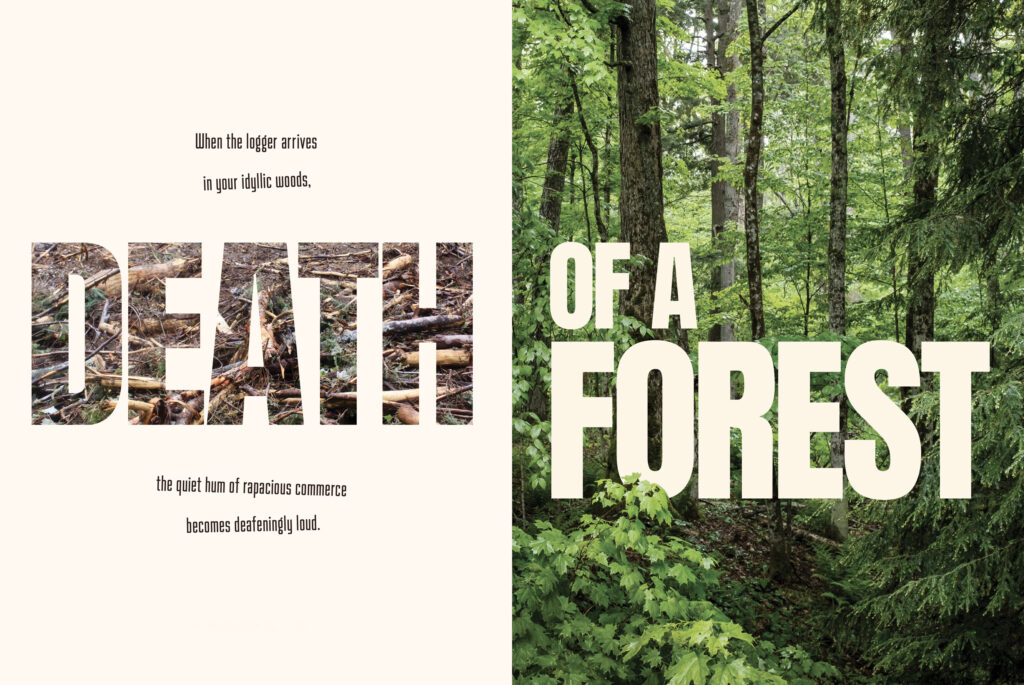
One day later, the crew and their formidable machines were gone. I walked down the road once again – to a scene of quiet devastation so complete it took my breath away. A tornado could not have done a more thorough job. Splintered wood of all sizes and dimensions practically carpeted the ground.
Discarded soda cans and oil containers provided odd notes of color. The skidder had cut ruts deep enough to become frog ponds, and limp green plants were strewn across the ground like tattered rags. Lingering above the shorn landscape was the incongruous smell of Christmas.
Witnessing the destruction of such a favorite, familiar place was painful in the extreme. This wasn’t some Amazonian rain forest or African savanna coming down – losses we lament in the abstract – but my home woods, and the pain was made all the sharper by the knowledge that I won’t live long enough to see the forest’s full recovery.
But my sorrow was complicated by a rising awareness. Standing in the wreckage, I had to reflect that here, after all, was humankind at work. We are a species of uncommon rapacity, using, even to the point of using them up, the materials at hand to fashion our chosen worlds. Loggers log, just as miners mine and farmers farm, because we buy what they have to sell; the color of the forest is the color of money.
How, I had to ask myself, was witnessing this crew at work any different from watching someone else kill the fish, chickens and cows that end up on my dinner table? How many trees had it taken – local spruce and fir, pine from the Pacific Northwest – to build my family’s little cabin down the road? Hadn’t our road itself begun as a narrow-gauge rail line carrying virgin logs to the Ontonagon mill? How many cords of firewood had I cut to stoke our stove?
How many wooden playthings – paddles, bats, racquets – were stored in our shed, itself made of wood? And unless you’re online at the moment, how many trees were fed into the indiscriminate maw of some paper mill to make the material on which you’re reading these words?
What I observed during that difficult August week was neither the slaughter of the innocents nor a happy instance of renewable forestry. Something deeper and more ambiguous was going on in the woods, and at its heart was a discomfiting lesson as old as Eve and Adam: In the loss of Eden, we’re all original sinners.