
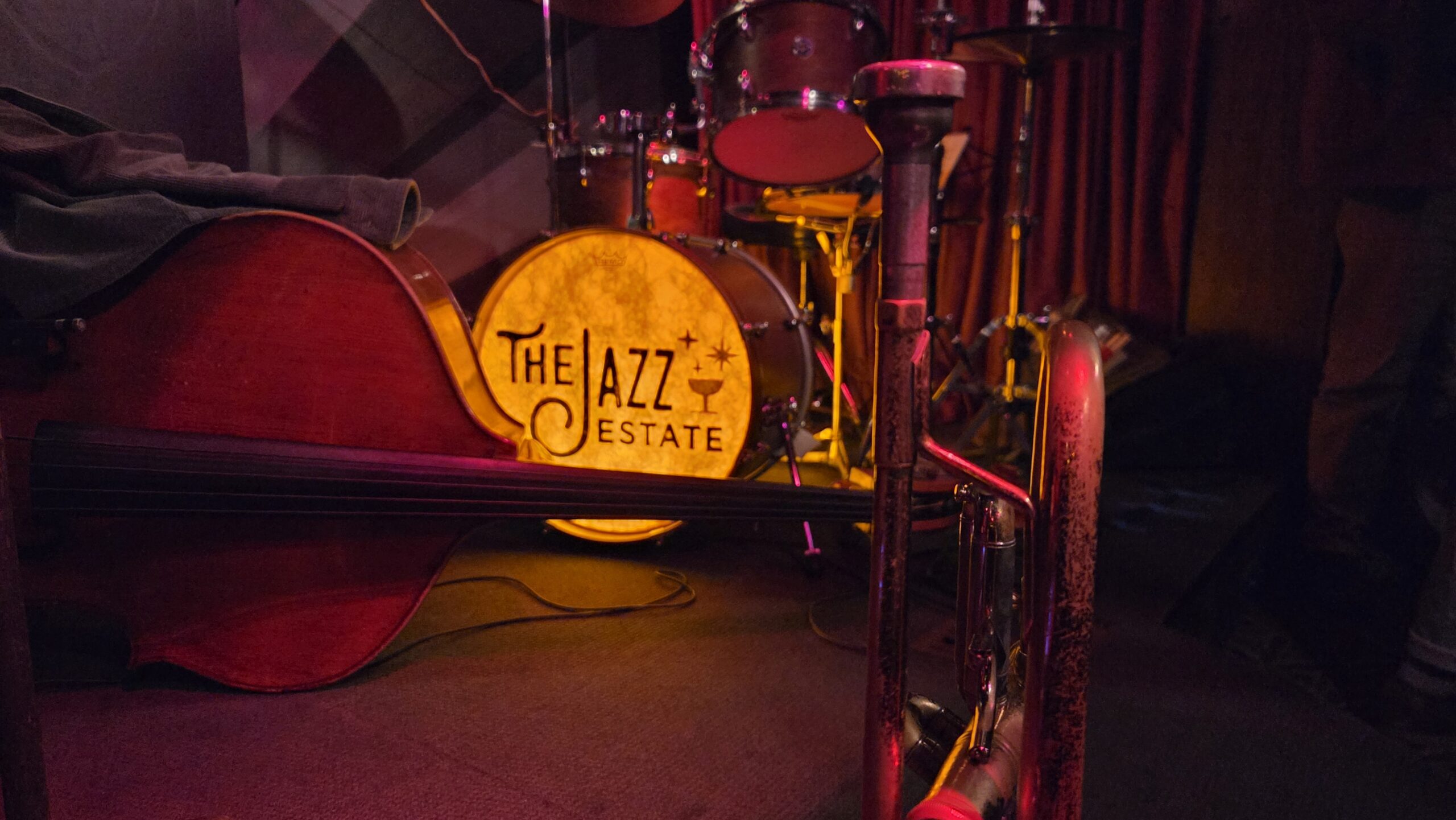
Music encourages looking back, and sometimes we look so far back we’re facing forward again. That’s what happened to me on my way to Murray Avenue’s The Estate last Friday night. I parked a couple blocks east so I could survey the Frederick Avenue duplex in which I befriended my future wife (and fielded countless noise complaints). The home was illuminated in an inviting purple, glowing beneath a nearly full moon, jogging memories of cosmic miracles, friends long gone and a life built together that’s leading to … who knows where? Tonight, it led me to the (formerly Jazz) Estate for a cool, cracking quartet ready to rip through standards and originals, leaving no doubt that jazz, like us all, evolves with one eye looking over its shoulder.
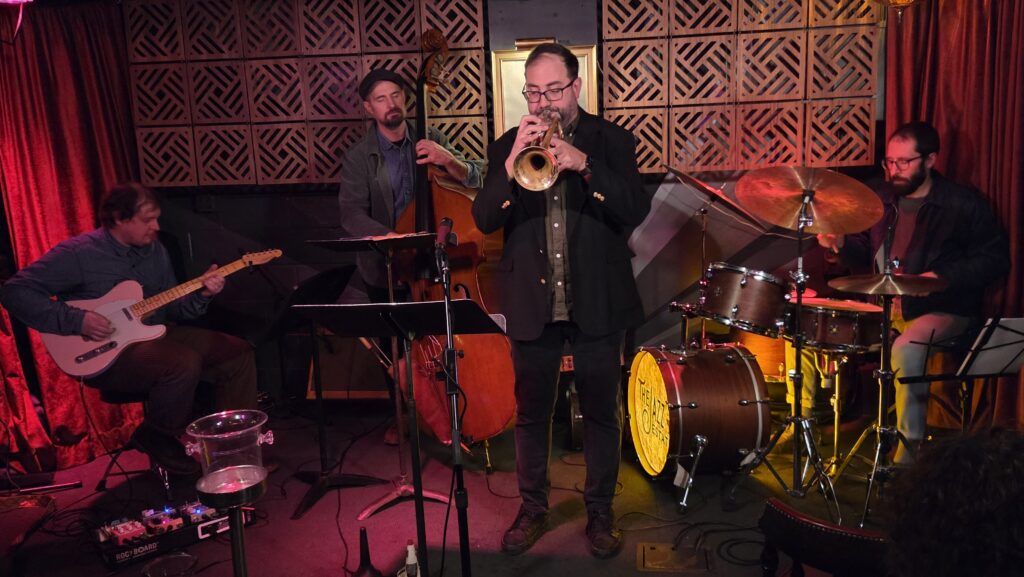
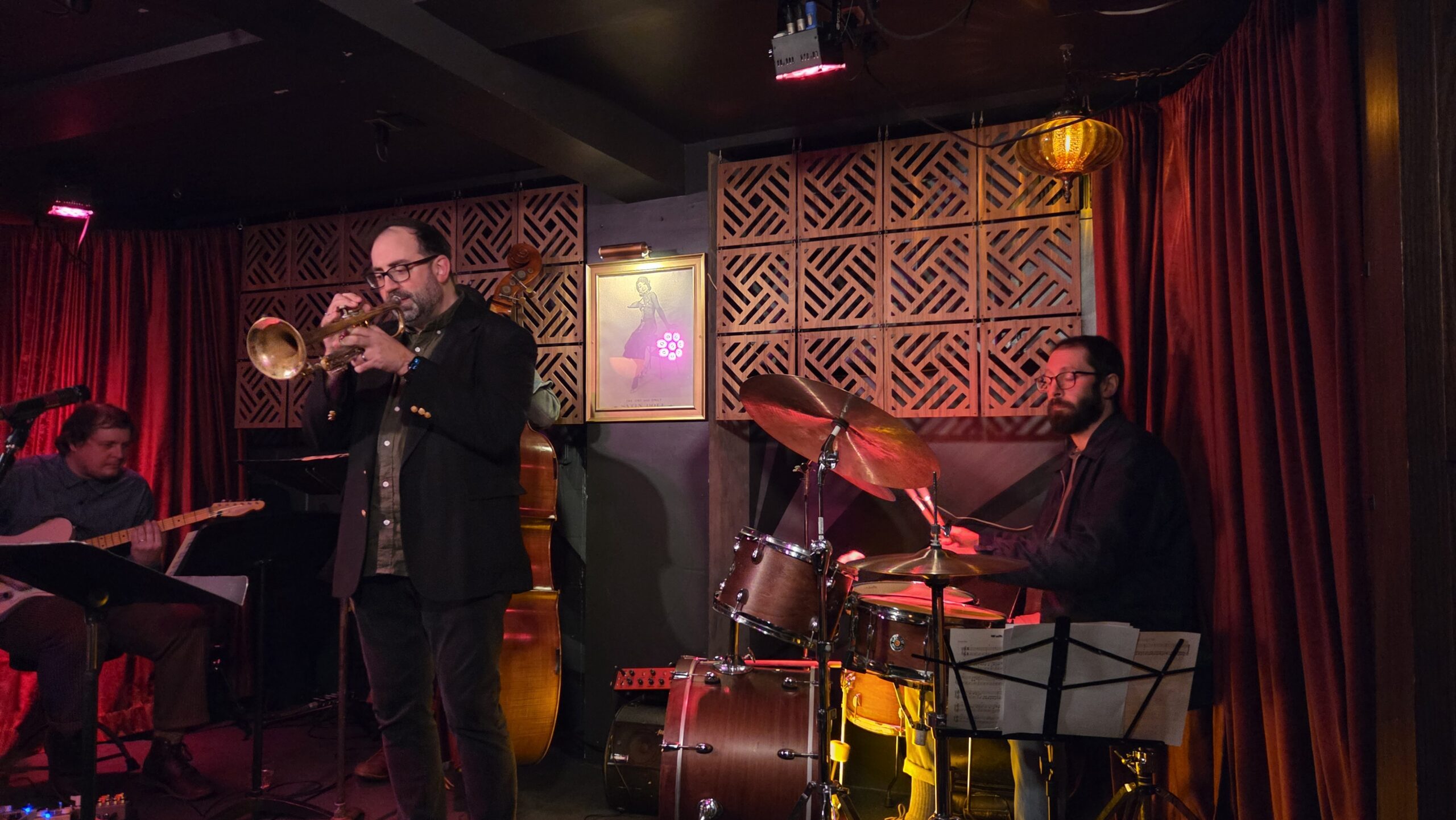
Please do yourself (and a friend or partner if you please) a favor and check out a band at The Estate. Intimate is not a strong enough word for the environment – let’s call it atmospherically inclusive to all attendees, musicians and staff. Led by the debonair manager Dave Cornils, I was escorted to a seat an arms-length from the drum kit, joined by seriously enthused locals, ready for the Trim/Breiwick Quartet to start swinging.

Celebrate this year’s winners of the Betty Awards!
The Trim/Breiwick Quartet Starts Swinging
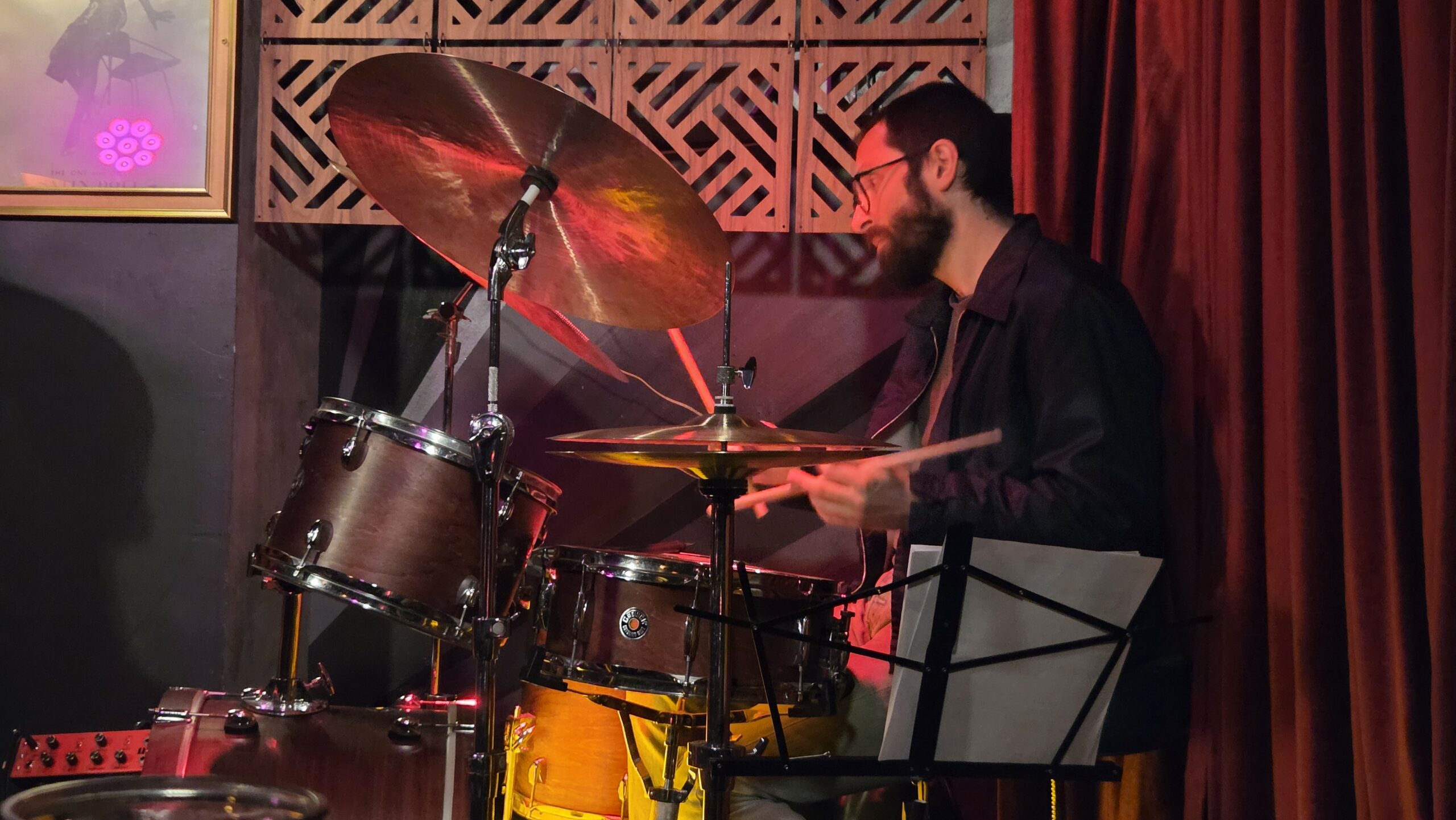
Have you ever sat so close to the drummer that you become just one of the many things he is playing? Fortunately, I enjoy being sort of an extra high hat, and Devin Drobka’s brushes landed with the speed of Sugar Ray Leonard’s gloves and the pleasing reverberation of an authoritative secret as the four musicians leaned into “One for Bill.” This Andrew Trim number is a beautifully troubled thing, with Breiwick on muted trumpet and sunrise swing, Drobka brushing the drum kit with soft sticks of dynamite and Clay Schaub paving the path on upright bass. The crowd was attentive, appreciative and wide-open to wherever this path might take them, which is a good thing because the pace accelerated with Trim and Drobka racing downhill in twin slalom, never losing control along an endless slope of sound.
Breiwick summoned an audience member for a tune. He announced that “this very tall person” is his son, Jack, who joined him on tenor saxophone for “Jack’s Corner.” The Breiwicks’ duet was a melodious treat, building gradually to a triumph: If a father ever wrote a song to play with his son, this is surely it, for it sounds right. Jack tore away soulfully on sax, standing (significantly taller) next to his father, mystifying the crowd who saw him moments before, scrolling his phone and sipping a soda at a nearby table. Jamie spotlighted his son for the conclusion of the tune and Jack slipped back to his seat, among the appreciative crowd.
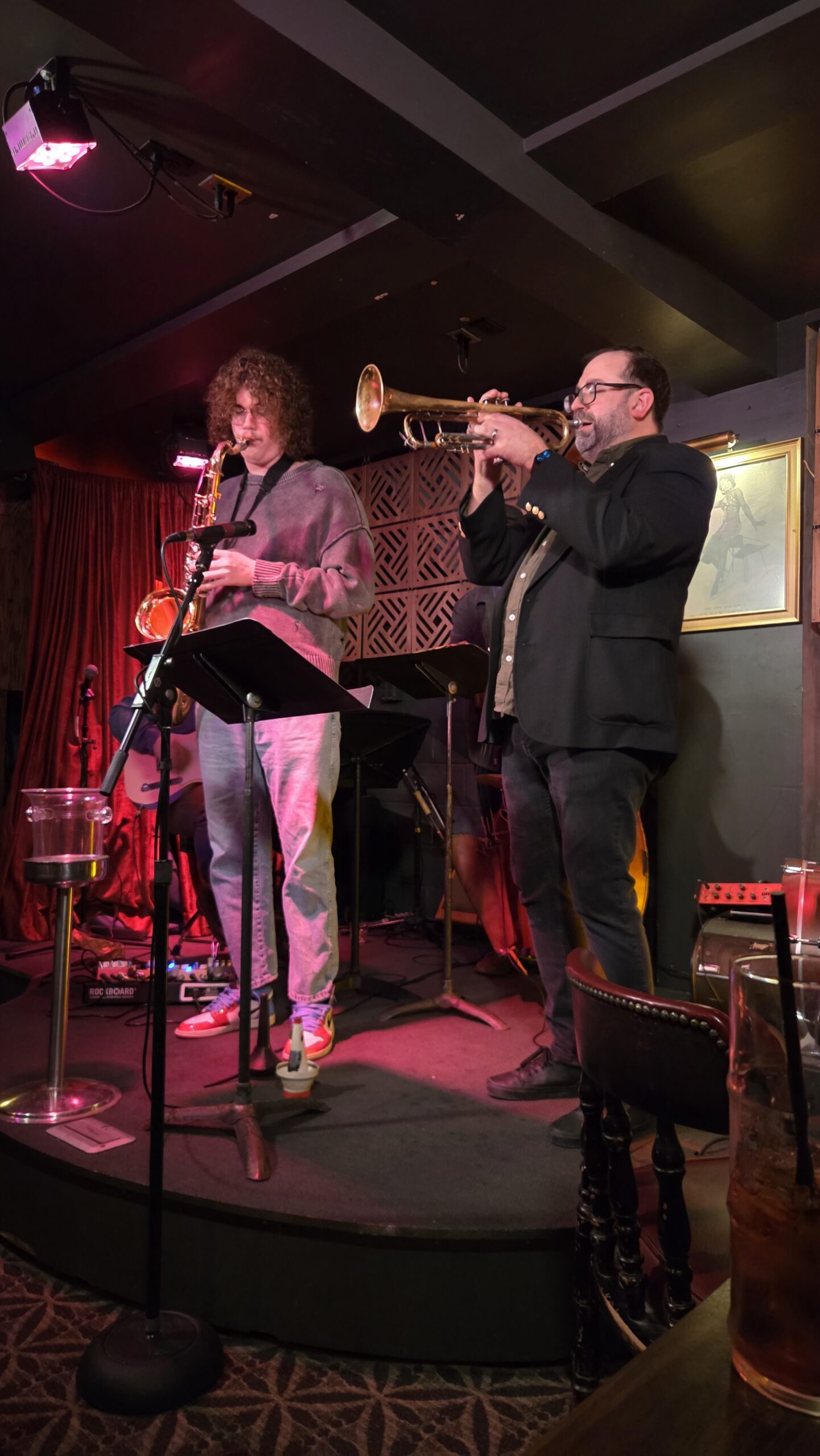
Following Trim’s lovely “Early Morning Train Platform Blues,” Jamie introduced a cover song by Daniel Johnston, entitled “Walking the Cow.” Full disclosure: I’m a huge fan of the song, both Johnston’s ramshackle lo-fi original and the menacing end-times version by TV on the Radio. The Trim/Breiwick Quartet freed “Walking the Cow” from its ominous abstractions with a somber, swinging homage to the troubled Johnston.
Next, the album’s title track and inspiration for the quartet’s coalescing, “Ordinary Poems,” chugged along in the best way, like an elegant electric train, all aboard to groove town. Bassist Clay Schaub intoned along with himself; Trim’s guitar leaped with lysergic spring; Breiwick blew at center stage and drummer Drobka was everywhere we want him to be. And everywhere we want to be is close together, in Milwaukee, enjoying live music in a local venue. Looking forward, and occasionally backward, to seeing you all out at a show sometime soon.
Set List from Friday, Feb. 28 at The Estate
- “MKE Blues” (Trim)
- “One for Bill” (Trim)
- “Sisters” (Schaub)
- “Jack’s Corner” (Breiwick)
- “Early Morning Train Platform Blues” (Trim)
- “Walking the Cow” (Daniel Johnston)
- “Ordinary Poems” (Trim)
Interview with Jamie Breiwick
How did you and guitarist Andrew Murray Trim connect?
Andrew grew up in Japan, lived in Denver and Chicago, and now he’s in Milwaukee. He had a sample of himself playing “Monk’s Mood” by Thelonious Monk. I sent him a message, just reaching out, said I really liked his playing, hoping some time we could play together. We connected when he moved up here, became friends and did a few gigs. He and I have a lot of mutual influences, musically. We had an idea of Andrew playing steel guitar and me on trumpet, kind of honoring two of our influences, Bill Frisell on guitar and Ron Miles on trumpet. We did a project honoring those guys.
Was that what became Ordinary Poems?
Yeah, we released that together and did a string of gigs in Milwaukee and Chicago. As a way to keep playing Ordinary Poems, we booked gigs with a full quartet, playing the same music we made as a duo, adding Clay on bass and Devin on drums. It’s a pretty specific reference point for that music, which is Bill Frisell on guitar and Ron Miles on trumpet but even a bit broader, the stuff those guys were influenced by: Thelonious Monk, Bob Dylan, the Great American Songbook. We also do a piece I arranged, a song by Daniel Johnston, the great, under-appreciated songwriter. We’ll play a Monk tune, Duke Ellington, Hoagy Carmichael, mixed in with our own originals.
Going way back, what were you listening to as a kid?
The first ever album I owned was a cassette tape of Thriller by Michael Jackson. Also, I had the 45 single of “We Are the World.” Those are some of the first musical memories I have … my dad had very eclectic musical taste. I remember Neil Young, Allman Brothers, Willie Nelson, Steely Dan, Donald Fagen – The Nightfly in particular, my dad played that a lot. Rock, folk, some country. Which makes sense, with what Andrew and I are doing – kind of Americana, American music, all of it.
What opened the door for you to begin playing instruments?
In fifth grade, we had a night where you could try out an instrument. I wanted to play the saxophone, probably because in the ’80s, every song had a sax solo. That night, they said we don’t have any more, the saxophone was full and they just handed me a trumpet.
How did you learn to play the trumpet?
I had a great trumpet teacher, Eric Weiss in Racine, who helped me with improvising and hipping me to recordings to listen to. I started listening to Miles Davis and Chet Baker, the first trumpet players I really got into. The flash point for me came in seventh grade when we had the opportunity to play in a jazz band. I had a great teacher, Doug Clum, who was very encouraging, not only in the teaching aspect but getting us performing opportunities outside of school – little gigs. I remember playing for a spaghetti dinner. It was such a big deal as a 12-year-old, being out of school playing music for people. I was honestly hooked since then. We played real jazz – Herbie Hancock and Duke Ellington. It wasn’t some watered-down school band arrangement.
And you became a music teacher.
I remember early on wanting to go into teaching. It seemed like a steadier life than just performing. Having a steady teaching job and being able to play seemed like a nice balance. I still play a lot, always do. I have taught since 2002, been at The Prairie School for 11 years now. The joy I get out of teaching is not dissimilar from performing. It’s immensely rewarding to see kids get that same excitement that I did. That’s my goal, to share that joy.
Do you find yourself learning from your students?
Every day. A lot of it is them turning me on to different types of music I wouldn’t check out otherwise. It is also helpful for me to verbalize what I do naturally without thinking much about it because I’ve been doing it for so long. Like working on improvisation or learning theory, it makes me think back: How did I learn it? How would I, now knowing what I know, appreciate learning the same thing? It’s challenging. It’s always different. (There are) definitely days where I feel like I have no idea what I’m doing.
What would you want parents to know about the importance of keeping music programs in schools?
I’m glad you brought that up, thinking about the state of education right now. You see a lot of places cutting music and arts. Places doing that are missing the benefits, which are many. There’s no shortcut to learning music – you can’t just pick up a saxophone and play it. It takes energy and practice and you’re gonna fail. You’re just gonna. The other benefit is working together. To play in a band, to play in a section, you have to listen so you can blend and balance with others. Your success depends on each other and working together. We also have to be on the same page and trust each other and listen to each other. The value in music is immense.
How do you balance teaching and parenting with performing live and recording music?
I also run a graphic design business – which is another hobby, a passion of mine – called B Side Graphics, mostly album art and posters. I’m doing stuff for Verve Records and other clients. I have four kids. Sometimes I have to disappoint people and cancel a gig, but that’s the key, just keep it in balance.
I admire that. A lot of outlets can be healthy. Do you find having all those different outlets inspires you as a musician?
I feel sometimes it would be nice just to have one thing to do. But they’re definitely all interrelated, from performing to teaching even to design. It’s all connected to music, and that’s a constant source of inspiration. It’s all good. I’m moving constantly, moving on to the next thing.
Speaking of the next thing, how did you get the Trim/Breiwick Quartet together for this show?
Devin Drobka is probably my favorite drummer I’ve ever played with. We’re in a trio called the Lesser Lakes Trio with bassist John Christensen. Clay moved here from New York because his wife is the piccolo player in the Milwaukee Symphony Orchestra. He’s phenomenal. Clay is so great. Any time we get to play together is a blessing. Aesthetically, those two guys fit in the direction of the music Andrew and I have written (for Ordinary Poems).
What’s inspiring you these days?
I’m really into architecture. Our school was designed by Frank Lloyd Wright’s apprentice (architect Charles Montooth). That led me to Bruce Goff, another architect. There’s a group called The Westerlies, a brass quartet. I just saw Sinners, that was amazing. There’s a great trumpet player named Ambrose Akinmusire. He’s got a record called Origami Harvest. It’s beautiful. He’s got a string quartet and different rappers joining him. I’m a big fan of Jason Moran, a piano player and visual artist. |He’s really pushing boundaries. He was part of the Kennedy Center music direction until recently … he did All Rise: An Elegy for Fats Waller. Moran has a deep respect for history while at the same time pushing forward. That’s been a big reminder for me. I have a lot of respect and reverence for the history of the music, but at the same time, I want to try and be myself and say something unique, too.