
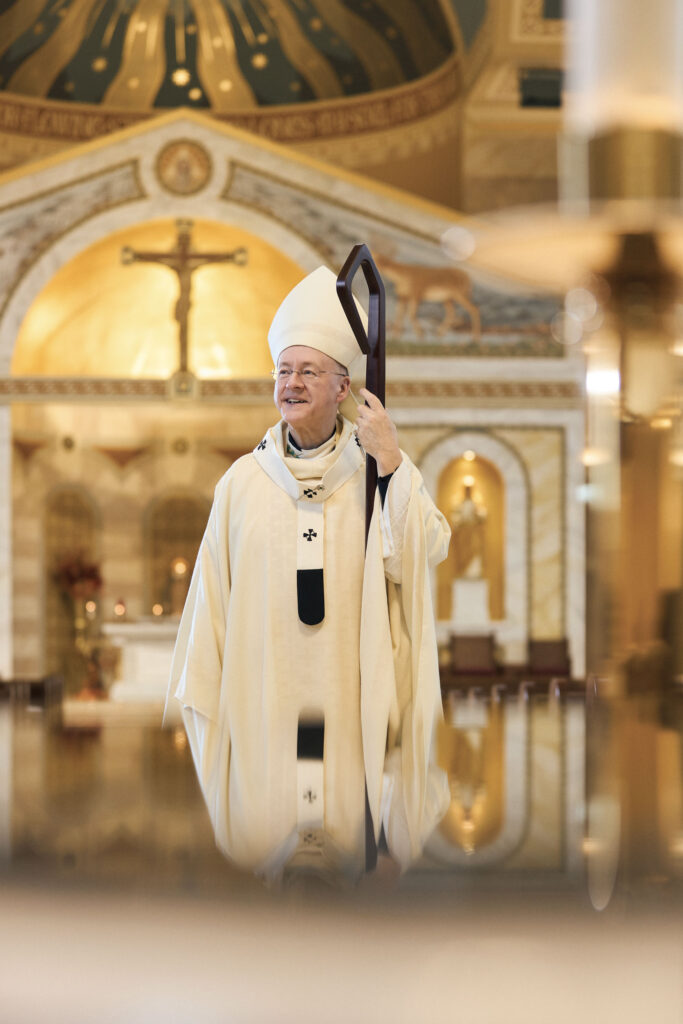
Jeffrey Grob was a Wisconsin dairy farm kid, milking cows in Cross Plains. He was an embalmer and a budding funeral director in Kenosha. He was a parish priest in Winnetka, Illinois. He was the chief exorcist for the Archdiocese of Chicago. And now he is the archbishop of Milwaukee, a role to which he was appointed in January. After nearly a year overseeing the Catholic archdiocese, Grob spoke with us about his background, the first American pope, his hopes for Milwaukee’s religious community and more.
What was your childhood on a dairy farm like?
The farm was started by my great-grandfather. You know, farming teaches you a lot of practical lessons about life: the sense of not being in control, the simple fact that you’re at the mercy of the seasons, the cycle of life. I grew up in that wonderful environment of hard work, of baling hay, of gathering crops, of milking cows twice a day. I raised a fair amount of wild game, because about a third of our farm was wooded. One summer, I had a pet raccoon.

Celebrate this year’s winners of the Betty Awards!
Did you consider becoming a farmer?
No, my vocation came early. Already in grade school, it was kind of haunting me. We had a beautiful old Gothic church, St. Francis Xavier. Being good Catholics, our family always sat one or two rows from the back. As a kid, I was mystified watching what was going on at the other end of the aisle. What was the priest doing? Even from that great distance, if anyone would block my view, I would have fits.
I went into a high school seminary, but after my first year of seminary college, I took four years off. I moved to Kenosha and, of all things, worked in funeral service. I didn’t have any grave doubts [about the priesthood], but I thought it was better to take time to explore. Funeral service was an incredible ministry, in a sense. You can do so much good, and you can do so much harm, caring for people in those vulnerable moments. I can’t tell you how many times I stood with people when they first walk in and see their deceased family member, how often they say, “Why didn’t we talk?” or ‘Why did we do this or that?’ and it’s too late. It’s a moment of reflection, to think, what are the things I should resolve while I still have the time to do it?
“If you’re going to plow a field, you’ve got to look forward. I put my hand to the plow 33 years ago as a priest, 28 years after that as an auxiliary bishop. Once you say yes to being a bishop, you belong entirely to the church. You’re called to serve, and you go. And my good fortune brought me to Milwaukee.”
— Jeffery Grob, Archbishop of Milwaukee
You returned to the seminary and became a priest and eventually an auxiliary bishop in Chicago, where you were also chief exorcist for nearly 20 years. What did that experience teach you about your faith?
Every first Sunday of Lent, the gospel reading is the Lord’s encounter with the evil one before he begins his public ministry. Often people hear those stories and think, “Oh, well, it’s just a story, or it’s an analogy.” To work in the ministry, you see people confronted by true darkness. It’s not just some amorphous thing. It’s a presence in reality. The evil one does exist.
We tend to sensationalize. It’s not all green pea soup and spinning heads. But you’ve got this malevolent being that is good at playing games, that is able to manipulate. The majority of stuff that comes from the darkness is to cause people to be disoriented, unfocused on God, in fear and isolation. It deepened my faith, certainly, in ways, and my devotion to the mother of God and the saints because we don’t function just on a physical plane. There’s a whole spiritual realm that surrounds us.
What did you think when Pope Francis appointed you to become Archbishop of Milwaukee?
I was surprised. When I received the call from the nuncio [a papal representative], it wasn’t a yes or no question. It’s simply, “The Holy Father has appointed you as archbishop of Milwaukee.” You know, I was just reading today’s gospel, from Luke, and it says, “Once you put your hand to the plow, you don’t look back.” If you keep looking back, that furrow is going to be all over the place. It’s a very cutting statement. If you’re going to plow a field, you’ve got to look forward. I put my hand to the plow 33 years ago as a priest, 28 years after that as an auxiliary bishop. Once you say yes to being a bishop, you belong entirely to the church. You’re called to serve, and you go. And my good fortune brought me to Milwaukee.
How has the first year gone?
Some days I still feel like I’m drinking from the proverbial firehose. God knows, I’m an extrovert off the charts. For me, it’s about being out with people. The office is beautiful, and administration and bureaucracy has its place. It’s, if you will, a necessary evil – I say that jokingly. Jesus didn’t sit in a synagogue and wait for people to come consult him. He was out. He was at the tax collector’s stand. He was at the shore of the sea. He was at the sycamore tree. He was out there, bringing the beauty, the truth of the gospel. To be able to represent the church at her best, to be compassionate, it fuels my own energy. I’m not a museum piece that’s kept on a shelf and periodically dusted off and brought out for a procession.
What have been some of the challenges?
One personal challenge, you know, is interviews. We live in a world of sound bites, and if you quip about something, maybe you mean it to be funny, it has an entirely different spin when it’s on paper or in the media. I don’t want to lose my freedom of being able to speak candidly. Especially in the polarized world in which we live, it’s all the more challenging.
A concern so many people have, is where are the young people, how are we ministering? How are we ministering to people on the fringes? It’s a credit to Archbishop Emeritus [Jerome] Listecki, the wonderful work that was done in his 15 years [on] the challenges he faced – bankruptcy, ongoing dealings with misconduct issues. We’re focusing on where to build, where to continue to grow the good things that are happening and to see what are the things that need to be tended to.
That 2011 bankruptcy after the sexual abuse scandal was a public reckoning for the diocese. Are you confident that safeguards against abuse are in place?
Very much so. It’s one of those things we can never become lax on. We must always remain vigilant, because what happened shouldn’t have happened. Fact is that it did happen. OK, so then, what do we learn, what do we continue to learn? Looking at candidates for the seminary, how do we review? How are we always putting in best safeguards, best practices? We can’t live in that moment, but we make sure that we’re always doing everything possible so that no child, and no vulnerable adult, ever experiences that again.
The biggest global news for the church is clearly its new leader. What is your impression of Pope Leo XIV?
Well, it was a shock for most people. People thought an American Pope would never happen in our lifetime. It’s always our nature to pigeonhole people. “Is he a Francis guy?” “Is he a Benedict guy?” From those who know him, I’ve heard he’s a very disciplined man of very deep faith. I trust that the Holy Spirit gives exactly what the church needs in a particular moment.
I went to receive the pallium [a vestment given to new archbishops in a ceremony in Rome] from him. I greeted him in English, and he tapped me on the chest with the back of his hand and said, “So, where are ya from?” We chit-chatted for a couple moments. He has this incredible presence. We’re in the Basilica [of St. Peter] filled with people, but the conversation felt like I was the only one there.
What are your hopes for your second year as Archbishop?
I still believe I have so much to learn. I want to visit all 187 of the parishes. There’s also beauty going on right now. We’ve got a $75 million renovation going on at St. Francis Seminary, for instance, the [newly opened] Seton Catholic Schools. I also hope to be a real catalyst to build bridges between local government leaders and other religious leaders. I’ve had the pleasure of meeting already with the Jewish Federation, other Christian denominations. I have meetings coming up with the Muslim community. We’re much stronger and can work to accomplish so much for good, to unify, rather than to be siloed.
You mentioned the polarizing times. What is the church’s role in that?
There’s always the challenge of civility. We’ve become so polarized and the divisions are so deeply seated – and they’re destructive. The gospel of our Christian faith calls us to look at the dignity of each person regardless of who they are, what color, creed, race, political party, what you’ve done. At the center is the dignity of the person. So, to be able to push back against saying, “Well, this group or that group.” There are tough questions. And the church struggles. Sometimes the issues are outrunning, in a sense, the moral thought. At the end of the day, we’re called by Christ to love. If we’re not doing that, who are we?