In the beginning, everyone thought public art could add a swirl of meaning to
a building or spice up a neighborhood. And it seemed such a bargain. “It’s
cheaper than fountains,” as Milwaukee developer Gary Grunau once put it. So art
could be put anywhere, and it would always be a good thing. Right?
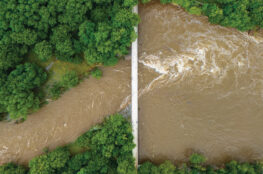
Well, maybe not. This view of the lake, without the John Barlow Hudson
sculpture, could have inspired George Innes (1825-1894), the 19th Century
American landscape painter.
So how did this happen?
Let’s follow the money >>
According to the artist, Jon Barlow Hudson, his sculpture “Compass” cost
about $30,000, including installation. It’s part of a suite of four sculptures
he did to accompany the new Brady Street Footbridge; the other three huddle at
the bottom of the bridge. The project cost $65,000 and was paid for by Milwaukee
County’s percent-for-art program.
Our percent-for-art program skims 1 percent off all public works projects
that cost more than $500,000. Every fire station, bridge or bike path becomes a
potential site for art.
The process starts with an RFP (request for proposal) and flows through
committees, including political appointees and community leaders (with a local
artist thrown in), that choose the sites and the art.
Inevitably, they choose more rather than less art. Many politicians,
neighborhood groups and art boosters see public art as a good civic deed. It’s
an irresistible and highly visible cut of political pork. Unless there is a
strong force to the contrary, the money will be spread around like fertilizer.
More art means more objects filling more spaces ever more cheaply.
Each year, federal, state and local programs produce thousands of RFPs,
creating a cadre of specialists who work the system. They’re not playing the
same art game chronicled in The New York Times. Percent-for-artists don’t do
galleries or museums, just as wedding photographers don’t get hired to shoot the
covers of glossy magazines.
Quality comes at a cost. The Crown Fountain in Millennium Park in Chicago,
designed by Spanish sculptor Jaume Plensa, cost $17 million. A small
off-the-shelf sculpture by Richard Serra starts at $3 million. Top art
photographs sell for more than a million dollars.
Translate these relative costs to automobiles. If the $17 million fountain is
equivalent to a luxurious $100,000 Mercedes, then a $30,000 sculpture is a $176
car. There is a price point under which a product loses all of its value. Either
Milwaukee County brought together a committee of savvy art buyers who beat the
market or we got what we paid for.
So why does the county buy at the absolute bottom of the market? According to
Lisa Berman, a member of the Public Art Committee, the art market “never came
up,” and she adds: “Artists don’t always get paid what they are worth.” Berman
may be speaking from personal experience. She told Milwaukee Magazine that she
has recently taken some photography classes at Milwaukee Institute of Art &
Design and was the designated artist on a recent panel.
Committee chair Murph Burke is more of a romantic. “The sheer joy of making
art is more important than what an artist makes financially,” she declares.
Burke may not be best person to explain that money doesn’t matter. After she
was appointed to the Wisconsin Arts Board, she and her husband, John Burke, gave
thousands of campaign dollars to former Gov. Tommy Thompson. The Burkes also
gave $1.5 million to the Milwaukee Art Museum and got the brise soleil named
after them. Calatrava didn’t design the Art Museum and John Burke didn’t make
tens of millions of dollars representing Indian gaming for the “sheer joy of
it.”
The market may not matter to Milwaukee County’s Art Committee, but it does to
artists. A prestigious project like the World Trade Center memorial received
5,201 proposals. An average $50,000 percent-for-art commission may attract 50 to
100 artists.
Milwaukee County has yet another class of commissions that have restrictive
guidelines, low budgets and poorly conceived time lines that discourage
applicants. Jon Hudson Barlow was chosen from a pool of five artists. That’s
right, five.
Burke seems unfazed. “There is a variety of numbers [of applicants] we get,”
she says. “On the most recent project at the Historical Society, I don’t think
we had five, we had four. It all depends on time lines and other specifics. The
policy as written is being fulfilled.”
If the policy as written attracts almost no artists, we have reached an
absurd state. Burke and company have taken over the percent-for-art franchise,
which was already like a fast-food restaurant, and made it even cheaper and less
nourishing.
How did this happen?
Let’s follow the history >>
The philosophy behind percent-for-art programs can be traced back to a bomb
that leveled the art world in New York. In 1981, Richard Serra’s “Tilted Arc,” a
12-by-120 rusted steel wall, was installed in Manhattan’s Federal Plaza. This
huge 72-ton, $175,000 work was financed by federal percent-for-art dollars. But
two months after its installation, a petition signed by 4,000 federal employees
working in and around the plaza demanded that the sculpture be removed. The New
York Times and Village Voice denounced the work as well.
They had a point – ‘Tilted Arc’ was an imposing obstacle to the use and
enjoyment of the plaza.
But the art world brought in its “A” team to assess the situation. The artist
Donald Judd called the work’s opponents “barbarians.” Said curator and historian
Fred Hoffman: “ ‘Tilted Arc’ makes sure that we do not fall asleep… in an
increasingly banal, undifferentiated and style-oriented world.” Serra declared
that “art is not democratic. It is not for the people.”
They were only half-right. “Tilted Arc” was a great work by a very great
artist, but it was clearly in the wrong place. Serra’s intention was to “alter
and dislocate the decorative function of the plaza,” as he put it. He succeeded
and turned the whole plaza into art. But lots of people preferred a plaza to
art, or would have even been happy having a plaza and art. After three days of
public hearings, a federal oversight panel decided to remove the sculpture.
It was a devastating defeat for the artistic elite, and for elite art.
Like the Manhattan Project, the Serra sculpture represented elitism at its
best – the government got the best specialist to do his best work at the best
price point. If “Tilted Arc” had been appropriately sited, it would have become
one of the most important public works in America.
Instead, its failure left the 24-year-old federal percent-for-art program
dead in the water. The “‘Tilted Arc’ controversy” became the defining moment of
public art. Art consultants make a living making sure a “Tilted Arc” never
happens again.
So the conversation changed. Artists started talking to rather than at the
people who have to live with the art. Public art took into account the
difference between an involuntary and voluntary art experience, how a plaza is
unlike a gallery or museum. Public spaces were conceptualized in new and
enlightening ways. Less aggressive forms of public art evolved. That’s the good
news.
But along the way, the baby was thrown out with the bath water. Selection
panels replaced art experts with people who had little or no art knowledge. A
new kind of anti-elitist public art evolved that replaced artistic
accomplishment with the same “community values” used to regulate pornography.
As artistic values were supplanted by community values, the game changed. The
by-laws of the county’s Public Art Committee insist that art “enhance and
preserve the artistic heritage and cultural history of Milwaukee County” and
“contribute to the civic pride of our community.”
Art-Free Art >>


Art consultants convinced everyone to see public art as an elixir that raised
our self-esteem. Whitney Gould, architecture critic for the Milwaukee Journal
Sentinel, explained that art will “bolster neighborhood pride and identity.”
So Barlow put an arrow in his sculpture to symbolize American Indians.
In Gordon Park, David Middlebrook’s $50,000 “Tip” boasts a “culture kit,”
with 13 logos symbolizing the people of the neighborhood, including “native
Americans,” “Irish writers,” “Germans,” and “Mexicans.” “Jews” in Riverwest are
“represented” by broken piece of the Old Testament and Vikings by sardines.
What’s going on? Jews do not need another logo. And Vikings?
We don’t need to “symbolize” ourselves. In fact, it’s usually insulting. A
symbol of goodness is not as good as an act of kindness. A tree is usually
better than a symbol of a tree. When it’s not, it’s a problem art is not going
to fix.
These objects are absurdly formulaic. There is nothing contemporary about
them. Neither are they historical. This new approach puts art through a
community values blender until it becomes scenic filler, like Hamburger Helper.
The Barlow and Middlebrook works are an amalgamation of different styles gone
bad, like when you goof around mixing paints and inevitably end up with brown.
Community values gradually but inevitably lead art into the realm of public
relations. Lisa Berman, a former PR person for companies like Harley-Davidson,
notes that the Public Art Committee on which she sits significantly changed the
Middlebrook sculpture. “We work with artists to do something we feel
communicates with the community.” The result is a subspecies of art that is
really a 3-D civic brochure. Its chief value is it will not “dislocate” anyone,
unless of course you happen to love art.
It’s almost the reverse of the “Tilted Arc.” Serra’s sculpture was too much
art and not enough consideration for the public. Now it’s all about the public.
We’ve got a new product without all of the calories – art-free art.
Yet this insipid art still commits Serra’s fatal error of violating a public
space. Today, all you have to do is call something “art” and you can put it
anywhere. Lowering the bar multiplies the errors, bringing art into conflict
with more places. Nothing can just be just a plaza, green space, building or
bridge.
We should be more skeptical of art boosters’ claims. Art is not an automatic
upgrade or new age remedy. It’s not a spice to bring out the flavors of the
city. If this art raises a neighborhood’s “self-esteem,” then what would you
need to do in exclusive River Hills? Life isn’t that simple; art isn’t that
easy.
The view from the top of Brady Street overlooking the lake needs our
appreciation more than a Barlow sculpture. If we are going to “enhance” our
city, we first have to comprehend what we are “enhancing.”
It’s counterintuitive to think that nothing is better than something. As soon
as Frederick Law Olmsted finished Central Park, he fought do-gooders who wanted
to fill it up with sculptures. But negative space defines the edges of a
subject. It creates relief in art and relief from congestion in cities. Negative
space makes the notes swing in music. It’s why we like to look at a baseball
diamond. As jazz musician Sun Ra used to say, “Space is the place.”
If we are going to have a real public art program, we have to admit that art
is not entirely subjective. Everyone won’t agree on each work on a case-by-case
basis, but that shouldn’t defeat the idea that some art is better than others.
Still unconvinced? Then just hire some designers to install a few nice planters
at the bottom of the Brady Street bridge.
The Barlow and Middlebrook sculptures are a symbol of the broken marriage
between art and the public in Milwaukee. Milwaukee County has commissioned more
than a dozen works, with more on the way. In a similar vein, there are other
projects commissioned by the County and other groups. Do any of these works
“enhance” their sites? See for yourself at www.milwaukeemagazine.com. As my
philosophy professor, David Hull, used to say, “The best way to get rid of a bad
idea is to spread it around.”
Many art folks dread a public conversation about public art.
Misunderstandings abound. Serra said art is “not for the people.” But he didn’t
mean that the way it sounds. Art must have an audience; it’s fundamental to the
act to assume someone gets it. Serra meant that, like science, it takes time for
the edge of art to be absorbed into the middle. In the early 1950s, people
wondered out loud about paint splattered across a huge canvas. By the ’60s,
“abstracts” were in art fairs and James Bond movies.
But you can’t speed up this process of absorption by creating panels of PR
people and politically connected do-gooders who presume to know what will best
communicate to a neighborhood. The city and state percent-for-art programs
follow the same policies, use the same kind of panels and get the same
regrettable results.
So how can we change what we’re doing? Here are a few simple rules. First, do
no harm. Why spoil our sublime parks? Bad art, in every case, is worse than no
art at all.
Second, don’t be cheap. It shouldn’t be too hard to figure out that good art
costs more money. Real estate developer Barry Mandel learned this when he went
shopping for art with private money. After looking at hundreds of sculptures
starting at $50,000, he paid $250,000 for the Beverly Pepper sculpture in Burns
Common at the intersection of Prospect and Ogden.
How can we afford to pay a lot more? Since 2000, the county has spent
$893,468 on dreadful public art. If we pool the money for a few years, it
shouldn’t be too hard to come up with a few million dollars for one great
project.
There will be much less art. But that wouldn’t be so bad. If we didn’t call
it “art,” there would be no justification for filling up gracious urban spaces
with ersatz logos that wouldn’t be allowed on Blue Mound Road. Getting good art
in the right places is tricky, but we can improve our chances if we do it less
often and more thoughtfully.
Third, let art be art. Our percent-for-art program diminishes both art and
whatever it is linked to. Art boosters and consultants have it all wrong. We
should make a bridge that doesn’t need art and art that doesn’t need a bridge.
Art isn’t a parasite that leeches off whatever it can get its hands on. Why turn
the powerful art brand that Picasso, Matisse and the Museum of Modern Art built
into cheap perfume?
Raising the stakes for public art will raise the level of competition as well
as the drama. It’s harder to sneak millions of dollars under the taxpayers’
radar. Politicians will become more alert. So will the press. Knowledgeable art
professionals will be consulted. The art market will be considered. Expectations
will rise. There will be more questions, a better conversation all the way
around. Public art will become more public. And most importantly, money and art
will both matter, as they should, for the artist and the community. We have the
wrong art because we’ve been asking the wrong question. Buildings, roads and
train stations don’t need art. We do.